Light-made topology: steering electrons in a Floquet topological insulator
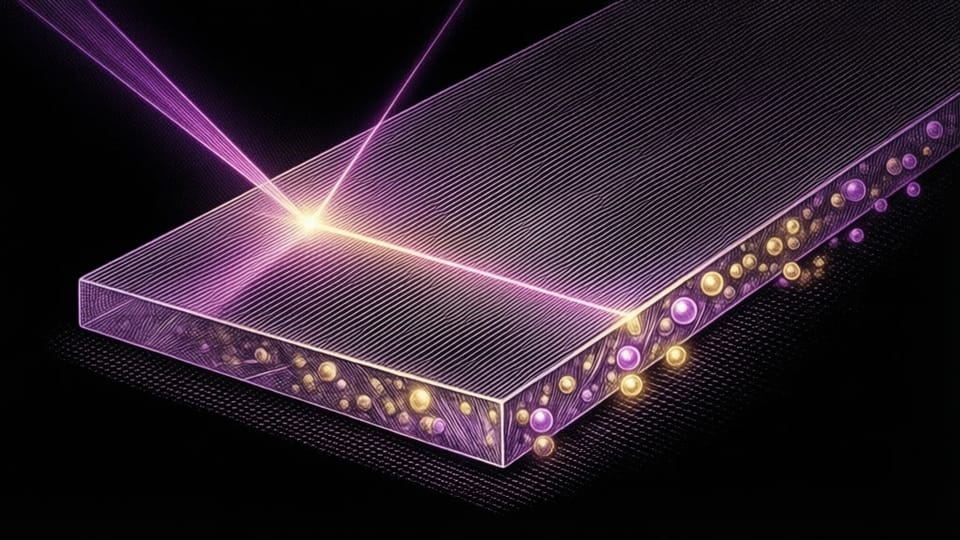
Graphene is trivial in the dark: no gap at its Dirac points, no Berry curvature, nothing to route an electron through except ordinary wiring. The prediction from 2009 and 2011 (Oka & Aoki, Lindner et al.) was that light could fix that. A Floquet state is a state dressed by periodic driving; dress graphene hard enough with circularly polarized femtosecond pulses and it briefly becomes a topological insulator with a light-opened gap. Now Lesko, Weitz, Wittigschlager et al. in Nature Physics have taken the step from creating the state to steering it: they dress monolayer graphene on silicon carbide with circularly polarized 1,550 nm pulses, then hit it with a second pulse train at exactly half the wavelength, 775 nm, phase-locked to the first — and use the relative phase between the two colours as a steering wheel. They call the method harmonic Floquet spectroscopy.
Why this is the step: creating the state had been seen before — McIver et al. measured a transient Hall signal under illumination in 2020 — but control of where the current goes, set by the sub-cycle phase of light, had not. Flip the helicity of the drive pulse (not the dressing pulse) and the photocurrent swings from 214 picoamperes to 12 — nearly two orders of magnitude. Graphene in the dark has zero circular dichroism by symmetry, so that contrast is the Floquet state announcing itself. Rotate the two-colour phase by π and the Hall current reverses direction: a knob on a direct current, turned on the optical cycle.
What is not shown: no quantized Hall conductance — quantization is calculated, and realising it is stated as an outlook. The state exists only while the pulses illuminate the sample: transient, picoampere-scale, room temperature, in vacuum. A measurement, not a device. One caution: a publisher correction ran on 23 September, so read the corrected version, not the syndicated write-ups.
What to watch: the power scaling and the wavelength. A purely perturbative two-photon process scales as intensity cubed; the measured exponent is 2.649 for co-rotating fields against 2.214 for co-linear — the departure from the cube says the process is not perturbative, and the gap between the two geometries, which the authors trace to an extra one-photon-resonance path that only the co-rotating field opens through the Floquet state's Berry curvature, is the state's fingerprint: physics no static material has. And the gaps scale with the dressing photon energy: at shorter wavelengths the authors expect gaps of hundreds of millielectronvolts, at which point room temperature stops being the caveat and becomes the selling point.

Comments ()